One-Time-Experience
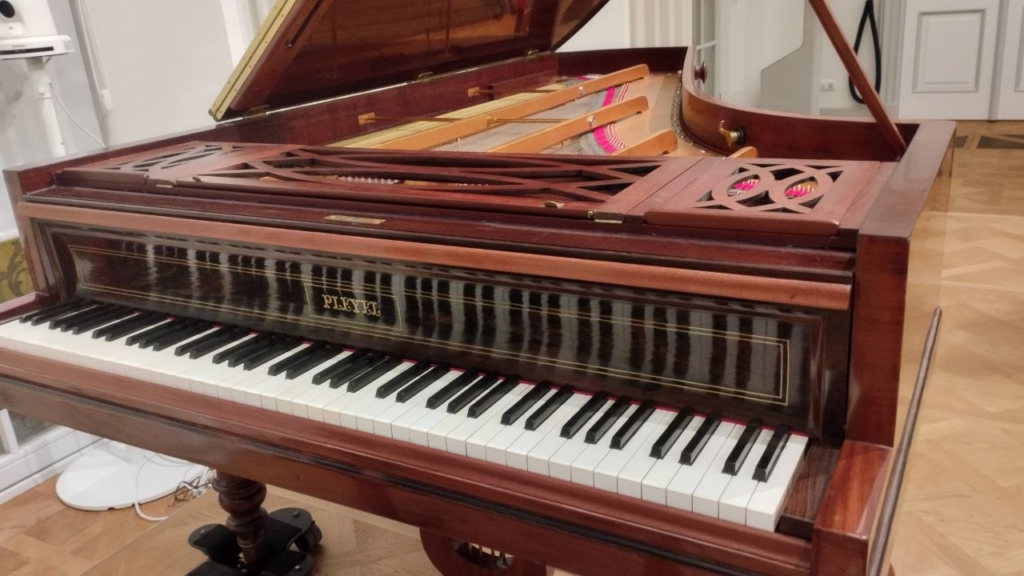
On Thursday, I travelled to Dresden, to the Bechstein Centrum, for a concert by the pianist Hardy Rittner, who had brought along a programme of Chopin miniatures. I went with enormous expectations. Not only had they brought an original historic Pleyel from 1846 for the occasion (think of it as a sibling of Chopin’s own piano), but I had also been deeply inspired by the few recordings of Rittner I had managed to listen to beforehand. I had the distinct feeling that he was hitting upon exactly my own idea of this music and its style.
Remembering my previous trip to Dresden to hear Sokolov (and travelling in that direction is not exactly a pleasant prospect for us at the moment), I began to worry that I had got my hopes up too high, and that I would be making my way home after midnight, exhausted by the long journey and full of regret. But, fortunately, this concert will most certainly remain in my memory for the rest of my life, among those very warm memories of rare musical revelations!
To accompany the thoughts that follow, I have put on Brahms’s First Piano Concerto, performed by Hardy Rittner and the L’arte del mondo orchestra under Werner Ehrhardt. Feel free to join me.

I cannot detach myself from my own thoughts, feelings and associations, so this will be a very personal review — or perhaps, rather, a conversation with Mr Rittner. Besides, an excellent review of the concert has already appeared in Neue (musikalische) Blätter.
Romantic Piano Style
I came to hear someone else perform the kind of Romantic piano style that, until then, I’ve heard exclusively in my head. Rich in colour, invention and virtuosity. I wanted to hear nocturnes sing, mazurkas dance, and impromptus being “composed” on the spot. And I sat through both halves of the concert unable to wipe the smile off my face, like someone stoned on Alpine oxygen after spending too long in stuffy basements!
The thing is, a year and a half ago, quite unintentionally, I found myself immersed in the study of Romantic performance practice, and Chopin’s style in particular. And what I discovered was nothing like what I had ever expected to hear. It was not simply a matter of pronunciation or some hidden meaning, but an entire universe of piano technique and aesthetics that has, in our time, been all but forgotten.
I would love to write: “First of all, they all used the pedal differently from the way we do…” But this style has so many features that differ radically from our assumptions about it that there can be no single “first of all”. Rittner, for instance, describes his approach to performance with the words “forgotten cantilena”, and I could not agree more that this aspect of Chopin’s virtuosity — one I have still not quite got round to exploring myself — is incredibly important. To sum it up briefly: Rittner invites us to search for hidden polyphony and to use dynamics and agogics with great subtlety, turning even the most even passages into something resembling bel canto. To go into a little more detail, alongside the familiar examples of hidden polyphony, he brought a couple of extraordinary ones to the concert: in the Fourteenth Étude and in the A-flat major Impromptu, Op. 29.
The pianos of the Romantic era had a completely different damper mechanism, different strings and string arrangements, and different hammers. As a result, neither pedal quite performs the functions we are accustomed to. The una corda pedal has very little to do with dynamics (let us not get lost in the intricacies of the duo corda and una corda mechanisms on classical pianos), but has a dramatic effect on tone colour. The sustaining pedal, meanwhile, does prolong the sound, but because the strings themselves decay rather quickly, it allows harmonies to overlap, creating a particular kind of aura. In this way, the creative role of the pedal takes precedence over its technical function in Romantic music. Ironically, on modern pianos it is precisely this creative use of the pedal that becomes extraordinarily difficult, even though its overall effect is much more pronounced than on the older instruments.
The performance tradition surrounding Chopin’s music in particular has drifted so far from the original character of its genres that hearing a genuinely waltzing waltz or a dancing mazurka on a modern concert stage is almost impossible. There are several reasons for this, the main one being the attempt to bring out every nuance of the articulation palette marked by Chopin. But when we restore the dances to their dance-like character, we run into a whole range of other interpretative problems. The main one is how not to sound like a rustic bumpkin next to those deeply refined, sentimental performances of mazurkas that break your heart. It is also surprisingly difficult to find the right agogic treatment for fiorituras.
On the whole, Romantic composers’ tempos are generally faster than we have grown accustomed to, largely because Romantic pianos are less capable of sustaining a cantilena. For me, this makes Romantic music a world of effortless articulation and soaring phrases. There is a certain spark in all Romantic music, something we usually associate with Mozart.
Another difficulty in interpreting the Romantics lies in the relationship between the instrument and their notation. Romantic notation is instructional. It does not express the musical idea; instead, it describes the choreography of the hands and feet (or, at least, the right foot). That is why, sitting at a modern instrument, even with some experience of playing Romantic pianos, it can sometimes be difficult to imagine what the composer actually heard when playing the music on his own instrument.
For my own work, I use two instruments, both of which are only approximations of the way a Romantic piano behaves. I practise either on a Viennese piano by Vinz. Oeser, which stands in our school, or on an old Alexander Herrmann upright from the GDR. Working with the instrument by Willhelm Wieck at the Robert Schumann House in Zwickau, and talking to its director, Thomas Synofzik, played an enormous role in shaping my understanding of the style.
The Pleyel, however, was an entirely new encounter for me at this concert, and I am incredibly grateful that I was given the opportunity to play it for a little while! I must say that even after listening to a whole concert performed on this piano, I still had not quite grasped its character. Besides, when I sat down to play the C-sharp minor Waltz, I was clearly still under the spell of Rittner’s divinely performed mazurkas, and I obviously failed to find the right genre. Still, I think it is worth including this short example:
If you look at each individual piece of this puzzle, none of it may seem particularly controversial. And yet many of the steps I have taken towards developing this new Romantic style have required quite a bit of courage. The first time I played Étude Op. 10 No. 6 at twice the speed of the fastest recording, I could not shake the feeling that my colleagues would cancel me for it. And yet this étude is probably one of my favourite interpretations from my latest Chopin programme. Every one of these decisions is difficult, not only methodologically but psychologically. Trying to play any Chopin piece while working on my programme felt like trying to pull my hands out of handcuffs, even if it meant breaking a couple of fingers in the process.
Alone in the Dark
An even greater ordeal, personally, was the complete silence from my colleagues on the subject. I was desperately looking for a dialogue. I wrote to former classmates, teachers and former students; I released a video on YouTube and tagged a few Chopin specialists in the comments. And I did not receive a single response from a pianist. Once, Zhenya Alexeyev wrote that my improvisation was worse than Chopin’s original fioritura, which made me unbelievably happy: at least it was some kind of reaction to what I was trying to explore.
The mainstream exerts a certain pressure, too. This kind of Romanticism is almost impossible to hear. In the world of Schumann and Schubert, in the world of songs, there has been a certain shift towards Romanticism: there is considerable interest in historical instruments, a number of talented recordings, a freer approach to phrasing and agogics, and a certain lightness in both piano playing and singing. But Chopin seems to have become ossified in a rather particular way, turned into a shop window for a dying world of “great classical music”.
And so the mere appearance of Hardy Rittner around us — the realisation that there was someone with a similar ear for this music, someone I could hear live and talk to — was the first genuine sign that I was not going mad. It was an extraordinary relief!
A Few Thoughts After the Concert
The way Rittner played the études made me think once again about the nature of the genre. I had always understood an étude as a small-scale form, something like an exercise or a virtuoso piece: in one way or another, a way of working on a particular technique, albeit a highly musical one. Chopin’s Op. 10 fitted this definition perfectly in my mind. Rachmaninoff’s Études-tableaux stood apart as a unique genre of their own, somewhere between an étude and a fairy tale or a story.
Rittner’s performance, however, prompted quite different, artistic associations. For a painter, a study is not so much a technical exercise as a quick sketch: a way of capturing a mood, a composition, a colour in a matter of moments. Of course, studies are often made for practice, but it is practice in the art of seeing. And in this light, Chopin’s études really sounded to me like little musical sketches — moments of life captured in sound.
It seems to me that we could look at the genre of the étude in general from this perspective. The Études-tableaux would then no longer seem to stand apart from the genre; rather, they would simply give it greater scale and a more elaborate treatment of detail.
I was also very intrigued by Chopin’s relationship with the polonaise and the way he developed it within his larger compositions.
As for the impromptus, I suddenly found myself wanting to discover that sense of immediacy in them: the feeling of improvising, composing on the spot, searching for the music as you go. Usually, this ends up sounding rather salon-like and affected. I tried playing the Fantaisie-Impromptu, Op. 66, with this feeling once, and I think I suffered from the same shortcoming. But despite all Rittner’s musicality and inventiveness in the impromptus, I sensed a certain polish and deliberateness in them, and I wanted to find a way to change that.
I suspect the secret lies in how we approach repetition. The initial idea can — and perhaps should — be, in a sense, felt out, discovered along the way, and then developed into a fully formed thought by the end of the piece. I ought to give that a try.
The Genius of the Performer
The concert did much more than simply confirm my thoughts on style and give me the joy of recognising a kindred musician. It also made me think deeply once again about the nature of the performer in music. I cannot say that the previous concert I travelled to Dresden for did not make me think about it, too 🤪…
But there are drawbacks to moving in the opposite direction. All of us young musicians feel that things cannot go on like this. We cannot play the same Chopin waltz for the thousandth time, with exactly the same dynamics, agogics, tempo and pedalling. And so, in reaction against this, we get Annique Göttler, who, yes, brings out the hidden polyphony and radically reduces the use of the pedal. In reaction against it, we get Roberto Poli, who advocates agogics instead of dynamics. In reaction against it, we get Lucas Debargue writing essays about performers being engaged in a dead art, and improvisation being our only salvation (incidentally, the one thing I missed a little at Rittner’s concert was improvisation in places where it would have been appropriate). In reaction against it, every other production of a classical opera is directed according to an individual artistic vision: the acts are rearranged, the characters are placed in exotic settings or different historical periods. Particular scenes are given an extra layer of meaning, or, conversely, additional characters are introduced to explain the drama to the audience.
None of these concepts is inherently bad. But very few musicians manage to travel even halfway towards the listener’s heart. Very few interpreters find a place for their concept within the music they are interpreting. And, frankly, very few interpreters successfully read even the composer’s text before applying their own concept to it.
Hardy Rittner performs this miracle. And another one, too. On top of a very strong foundation — what we now call historically informed performance — on top of the composer’s intentions and a deep understanding of genre and style, he creates his own performing language, his own aesthetic.
Today I listened to many recordings by great pianists: Sergei Rachmaninoff, Eileen Joyce, Arthur Rubinstein, Martha Argerich and Friedrich Gulda. Each is recognisable within just a few bars; each bears the imprint of their own era and has a musical language of their own, something that cannot be written down in the score. Everything in my own musical nature resists playing in the language Martha Argerich speaks, and yet I listen to her with immense pleasure. Hardy Rittner’s language, on the other hand, feels closer to me than ever, and at the same time I have repeatedly been astonished by the aesthetic he has found for himself. I’m trying not to draw parallels with Sokolov’s concert, but I can’t help it: whilst there I heard an unfulfilled potential in every phrase, at this concert I was constantly surprised by the music that emerged – music I hadn’t heard in this piece before. I have a very similar feeling about the playing of Pavel Kolesnikov, who just a few days ago released an album featuring all of Chopin’s nocturnes.
For Rittner, the Pleyel of 1846 is not an instrument from a bygone era, but a thoroughly modern piano, rich in expressive possibilities. Several times during the concert I found myself surprised by things I had not known a piano could do. I would also be extremely interested to hear contemporary music written for this instrument.
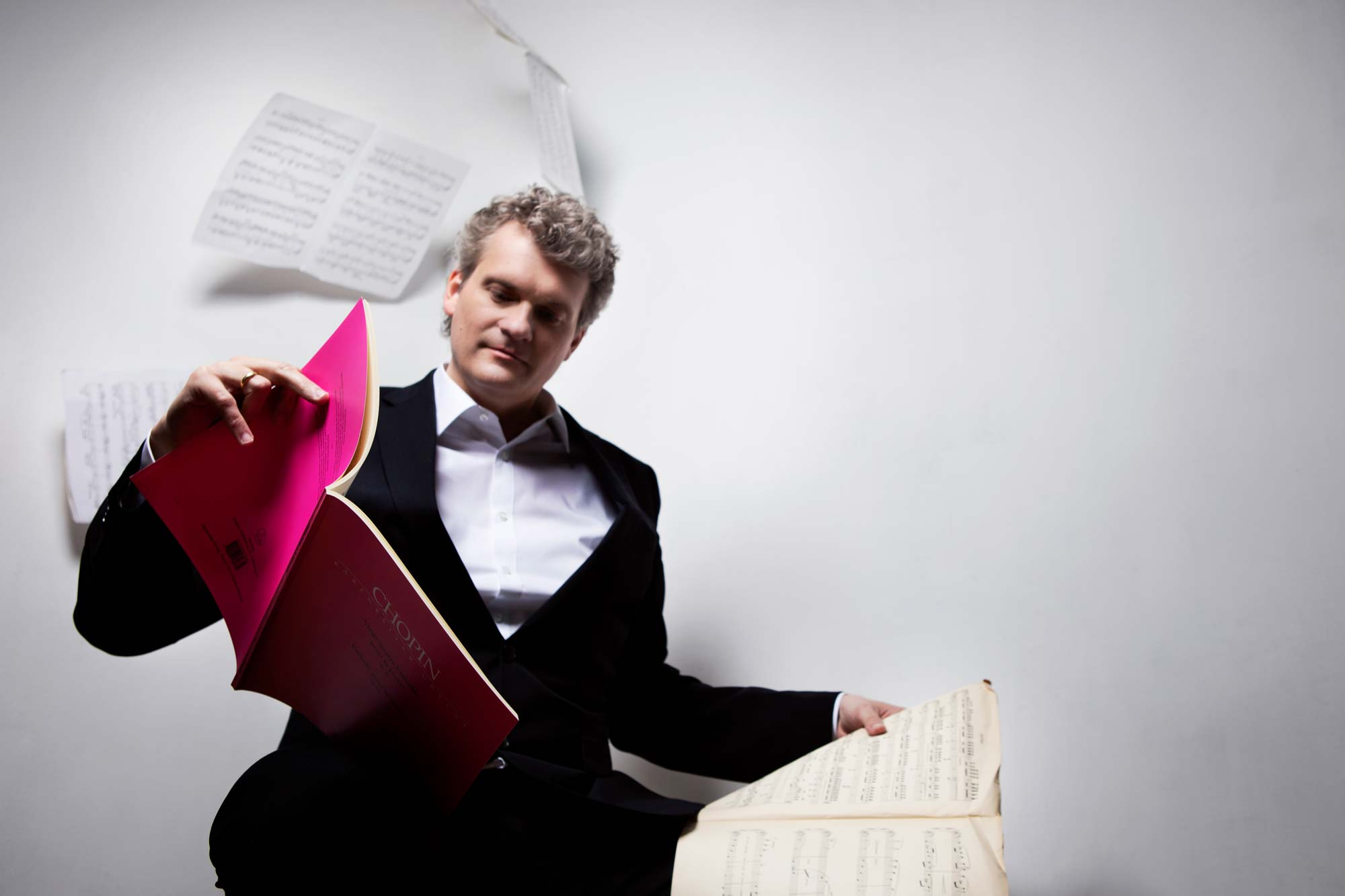
©Hardy Rittner’s Photo by Frances Marshall